


From the Oval Office to Oval Sunglasses: Jackie Kennedy, The Style Icon
What made Former First Lady Jacqueline Kennedy Onassis such a style icon?

Getty Archive Images

Getty Archive Images
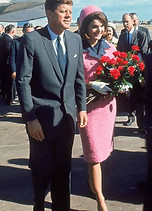
JFK Museum Collection


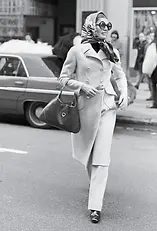
Born to her parents as Jacqueline Lee Bouvier on July 28, 1929, this fashion icon of the ‘60s and ‘70s was the woman better known as Jackie Kennedy, former First Lady to President John F. Kennedy or “Jackie O.” Her family lived in Southampton, New York where her father was a wealthy stockbroker on Wall Street. Her father’s family had come to the United States from France in the 1800s, and Jackie always seemed to have a connection to the country in her own ways.
After finishing high school, Jackie went to Vassar College in New York to study history, literature, art, and French. She even spent her junior year studying abroad in Paris. However, upon returning to the United States for her last year of college, Jackie decided to transfer to The George Washington University to be closer to her family in the city. This brought her to her first job for the Washington Times-Herald newspaper where she took pictures and conducted interviews— including various politicians.
It was during her time in this position when she met the future president JFK when he was currently serving as a congressman and was soon to be elected senator of Massachusetts. The two were married on September 12, 1953. However, it was not until January 20, 1961 when she became the First Lady of the United States, and from then on, Jackie’s life was forever changed. She quickly became one of the most sought after people and the paparazzi often swarmed her trying to take her picture.
Known for wearing delicate pastel colors, pillbox hats, and matching sets, Jackie represented the classic and respectable style of fashion for this time period. At this point, she was generally considered by the public to be an altogether fashionable woman.
However, she was not yet the icon that she would later become…
In less than three years into his presidency, President John F. Kennedy was assassinated on November 22, 1963, in Dallas, Texas. Jackie was right by his side to witness the horrific scene and her clothing is often regarded as one of the most famous pieces of fashion history. This is because of the decision that was made to not clean her outfit and to instead preserve it, locking it away for 100 years before revealing it to the public. Following her husband’s death, Jackie created the JFK Presidential Library and Museum as a memorial.
After the tragic assassination of her husband and the President of the United States, Jackie had become a widow at only 34 years old. However, despite no longer being the first lady, paparazzi were more relentless than ever, and now she had significantly less protection. And to make matters worse, it seems as though the public became even more infatuated with Jackie after her second marriage to Greek shipping magnate, Aristotle Onassis, in 1968. While she was always a considerably stylish person, Jackie did not become the fashion icon we know today until she began her relationship with Onassis.
Drawing back on her family history and her own personal fascination, Jackie was most inspired by French and European fashion, often wearing timeless, elegant, styles. However, she was perhaps most well-known for her signature Gucci bag and oversized sunglasses. Originally introduced by Gucci as the G1244 or the “Fifties Constance”, the bag became famous for being a favorite of The Jackie Kennedy Onassis. She even had multiple colors and variants of the bag to match any outfit.
She was relentlessly pursued by paparazzi while she was living in New York during the 1970s—often using her Gucci bag as a shield from the flashing photographers. Once she had been continuously photographed with the bag and established it as a wardrobe staple, the Gucci brand capitalized on this and began marketing the bag in this way. The Gucci brand even decided in 2020 to rename it in her honor, now calling the style “The Gucci Jackie 1961” or simply “The Jackie.”
As a way to conceal herself from the prying paparazzi even further, Jackie was also frequently seen wearing her iconic large framed sunglasses. She wore a variety of brands over the years such as Nina Ricci, Francois Pinton, Traction, and Maison Bonnet. Although the most recognizable style worn by Jackie were the Spa.2 rounded butterfly sunglasses made in the late 1960s by the Parisian eyewear brand, Francois Pinton.
Today, Jackie Kennedy Onassis is still considered one of the most fashionable women of 20th century American history. Perhaps her style became so iconic for being the perfect blend of the classic and respectable first lady she once was with the more confident and mysterious woman she had to become.

Getty Archive Images
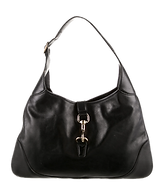
Gucci
Getty Archive Images
Getty Archive Images
Getty Archive Images
Sources:
Harper’s BAZAAR. “The History of the Hero: The Gucci Jackie 1961,” May 3, 2023.
https://www.harpersbazaar.com/uk/fashion/a42633911/gucci-jackie-bag/.
Kim, Leena. “A Brief History of Jackie Kennedy & Her Gucci Bag.” Town & Country, September 20, 2024.
https://www.townandcountrymag.com/style/fashion-trends/a62249117/jackie-kennedy-gucci-bag-history/.
The John F. Kennedy Presidential Library and Museum. "Life of Jacqueline B. Kennedy." March 31, 2026.
https://www.jfklibrary.org/learn/about-jfk/life-of-jacqueline-b-kennedy
Bartlett, Jamie. “Jackie O: An Eyewear Icon.” Banton Frameworks, December 20, 2023.
https://www.bantonframeworks.co.uk/blogs/eyewear-icons/jackie-o.