


Bathing Suit Revolution: The History of the ‘Teeny Weeny’ Bikini
When was the bikini swimsuit invented?

Godey's Lady's Book - 1867
The Collections of the Library of Congress

The Collections of the
Bikini ART Museum
The Collections of the
Bikini ART Museum

The Collections of the Library of Congress
Victoria & Albert Collection
.webp)
Getty Archive Images

Getty Archive Images
Sources:
Charleston, Beth Duncuff. “The Bikini.” Timeline of Art History, October 1, 2004.
http://www.metmuseum.org/toah/hd/biki/hd_biki.htm.
Davidson, Lucy. “What Was a Victorian Bathing Machine?” History Hit, March 2, 2022.
https://www.historyhit.com/what-was-a-victorian-bathing-machine/.
History Today. “The Bikini,” July 5, 2022.
https://www.historytoday.com/archive/months-past/bikini.
K, Kym. “Bikini and the Bomb: A History of Swimwear.” The Seamstress of Bloomsbury, June 21, 2023.
On July 5, 1946 a French designer and car engineer by the name of Louis Réard created a new style of swimwear that he named the ‘bikini’. Fast forward to the modern day and the style has become one of the most popular choices when it comes to women’s swimwear and is still ever-changing.
However, there is a much deeper history to uncover throughout the centuries leading up to this revolutionary design…
For thousands of years men and women would recreationally bathe (or swim) in the ocean or in bathhouses as a leisurely pastime for all social classes. This was an activity that was typically done in the nude, but it would not stay this way. Britain was especially strict over what styles of bathing attire were allowed to be worn in order to ensure modesty, ultimately shifting towards more prudish perceptions of the body.
Following the fall of the Roman Empire, many upper class people believed that the ocean carried certain diseases and instead opted to bathe exclusively in bathhouses. Although by the 1700s it was once again fashionable for them to go swimming in the ocean as a healthy pastime. Swimming in the sea had never stopped being a popular activity for the peasant classes who accounted for most of the British population, however, it seems that once the upper classes joined the rules on swimwear became much stricter.
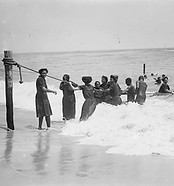
The ideals of modesty surrounding women’s dress of the time carried over into what she was socially allowed to wear whilst swimming and walking near the seaside, even if it was impractical. A standard bathing outfit would often consist of “...a loose, open gown typically made from wool or flannel with a pair of bloomer-like trousers under the gown along with stockings/socks” (The Seamstress of Bloomsbury). These outfits were extremely difficult to move in when wet because of the many layers of thick absorbent fabrics, and to add to this heaviness, small lead weights were frequently sewn into the hem to avoid the skirts from floating in the water and exposing them.
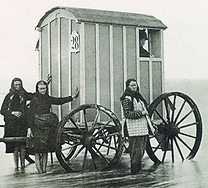
The bathing suits of the Victorian era (1837-1901) continued the overarching trend of keeping modesty, but the skirt length did become shorter over time to allow women a bit more mobility in the water. However, drawers and stockings were still worn as a way to protect the woman’s legs from being seen. Another albeit more quirky way that Victorians would ensure modesty was through the use of ‘bathing machines.’ These were small transportable dressing rooms intended for women to use to change in and out of their swimming attire in privacy while at the beach. They were either on wheels or on a track that allowed them to easily be brought down to the seaside and back up to solid ground again.
By the end of the Victorian era a new style of one-piece became popular, featuring a blouse-like top with attached shorts, as well as a knee-length overskirt to provide extra coverage. Women’s swimwear would continue to look similar to this style until the 1920s when the hem of the one-piece swimsuits started to become shorter, stockings were completely abandoned, and the necklines started to get lower. Advancements in the textile industry also made significant changes by using lighter weight and eventually waterproof fabrics.
However, in the United States there was still significant resistance against the more revealing swimwear. Some beaches were even patrolled by “Swimsuit Police” who ensured women’s hemlines weren’t too short by measuring them with a tape measure. If they did not meet the requirement these men would either issue a warning or sometimes even take her to jail. By the 1930s these restrictions had begun fading away as the one-piece swimsuit became normalized, most likely due to them being frequently featured in Hollywood films. Censorship laws of the time strictly prohibited lingerie on screen, however swimwear was seen as a work around because of its connection to sports. Swimwear in the US had almost always been closely tied to practicality and athletics, however, in France and other parts of Europe it was instead seen as a fashion statement and was intended for relaxing.
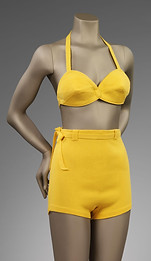
The two-piece swimsuit first started gaining popularity in the early 1940s, and consisted of high waisted bottoms that came above the navel paired with a bra-like top. These suits were not the same as the bikini that would come in the latter half of the decade. These two-piece swimsuits were typically not viewed as much more scandalous than the single suit and had relatively the same hemline. Due to strict World War II rations, the two-piece style was in some ways even patriotic for using less fabric, and for many people, it was also a well-received distraction from the ongoing war.
It was not until May of 1946 that a Parisian designer by the name of Jacques Heim pushed the boundaries of modesty with his new two-piece swimsuit which he claimed was “The world’s smallest bathing suit”, aptly naming it after the smallest thing in the world– the atom (L’Atome). However, Heim’s design was swiftly replaced as the smallest swimsuit by a design which, even for today’s standards, could still be deemed as “too revealing” by some. On July 5, 1946 a French car engineer and fashion designer, Louis Réard, created something which he boasted was “Smaller than the smallest swimsuit”. The creations were fairly similar, but Réard’s design differed from Heim’s because he dared to take the extra step to expose the navel, something that had not been previously done in swimwear fashion history.
Furthermore, in a truly cheeky move, Réard named his design the ‘bikini’ after the atomic testing site, Bikini Atoll in the Marshall Islands which had begun only four days before his design went public. Réard’s bikini was made with less than one square foot of fabric cut into four triangles held together by string. The original could even fit into a tiny box in the palm of your hand and later the qualification for a true bikini was based on whether it could pass through a wedding ring. Having created a swimsuit design nearly half the size of Heim’s, Réard had effectively split the atom.
Because the swimsuit was so scandalous, Réard hired 18-year-old nude showgirl Micheline Bernardini to model his creation for the Paris fashion press since all the runway models refused to do so. Here are two photos of Bernardini, one where she is modeling the original bikini, and another where she wears the famous design 40 years later. Although Heim’s designs ended up being more of a commercial success, (Réard’s bikini design was banned from some beaches) the name ‘bikini’ is what the general style became referred to from then on. Just like with earlier new swimwear designs, Hollywood helped to popularize and normalize the bikini until it eventually was just seen as another style of swimwear.